
In Search of the Thunderbird
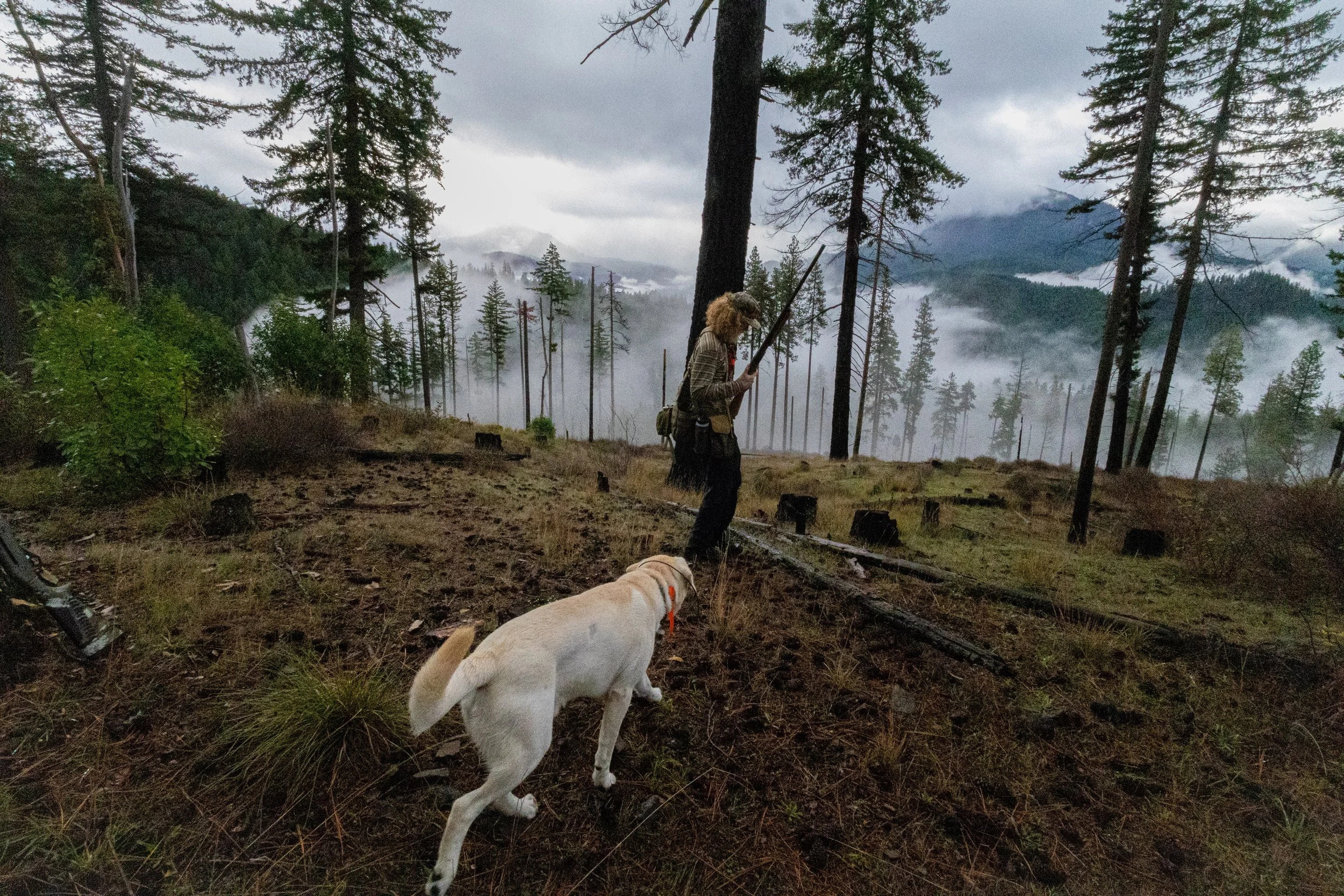
Patrolling a cut
The thunderous beat of a grouse flushing is a sound that is forever ironed into your memory once heard. Upland hunters chase the giddy feeling it evokes like teenagers performing their late night summertime antics. A mix of excitement, surprise, and challenge are the perfect concoction of emotions to keep you coming back for years. The first time you hear a grouse flush, you would think something is jumping out of the brush at you. Seeing a small, rotund chicken-sized bird fly through the woods at thirty plus miles per hour seems physically impossible and ridiculous. The chase for what some call the “king of upland birds” often emerges from an encounter, deep in the woods, that initially scared the daylights out of you.
Upland hunting is a term that delineates the hunting of ground dwelling birds, specifically. These birds are from the scientific order Galliformes, which is composed of heavy bodied birds that are primarily ground dwellers. They have powerful legs for running, and evading predators. Their wings, unlike other birds, are used for powerful, short bursts of flight to evade predators that have gotten too close. They are the sprinters of birds, unable to fly long distances like many other species. Because of the physiological structure of birds in the Galliformes order, they inhabit different habitat and exhibit their own unique behavior compared to waterfowl, raptors, songbirds, and other fowl. This style of hunting has its roots in aristocracies of Europe, being a sport which emerged out of excess. The fortunate individuals who upland hunted did not hunt for sustenance, but rather for sport. There is no sport in shooting a bird frozen in fear, or for camouflage; this birthed the idea of “wing shooting,” only shooting birds once they took flight. This changed the idea of hunting for food into a challenging sport that also leveled the playing field a bit, giving the birds a chance to escape; which, to a novice hunter, is almost always assured. To this day, upland hunting has what some consider a “posh aura” surrounding it. The sport is saturated with elegantly engraved shotguns and purebred bird dogs with perfect proportions. But don’t let this deter you; dipping your feet into the sport doesn’t have to break the bank.
Oregon is blessed with an extremely diverse array of upland bird species. The state has five native species of grouse, two native types of quail, introduced ringneck pheasant, introduced turkey, and two introduced partridge from Europe and Asia. Upland hunting in Oregon can be broadly divided into distinct areas, Eastern and Western Oregon. The dividing line exists, for sake of simplicity, on the Cascade Range. Hunting in the valley generally occurs in the heavily forested areas in our mountains. Out east, hunting is more wide open, as there is objectively less vegetation. You can chase wild pheasant, valley quail, and Hungarian partridge on public agricultural land and both chukar and Hungarian partridge the sparsely vegetated, rocky hillsides of Eastern Oregon.
On the west side of the Cascades in the valley, we have access to two native types of grouse: ruffed grouse and blue grouse. Grouse, as mentioned above, are ground dwelling birds that resemble chickens; in fact, ruffed grouse are sometimes referred to as ditch or thunder chickens. They are the most widely distributed resident game bird in North America, commonly referred to as the “king” of upland game birds due to their speed, agility, and difficulty to hunt. They are the most common grouse in the valley, inhabiting both slopes of the coastal range and cascades. Blue grouse are much larger, and typically inhabit higher elevations and exhibit an arboreal life strategy in the winter, retreating to the upper canopy feeding on fir needles until spring. As a result, blue grouse are most commonly chased in the early season. Our valley grouse, especially ruffies, are primarily solitary birds that rarely form large “coveys” like their quail counterparts.
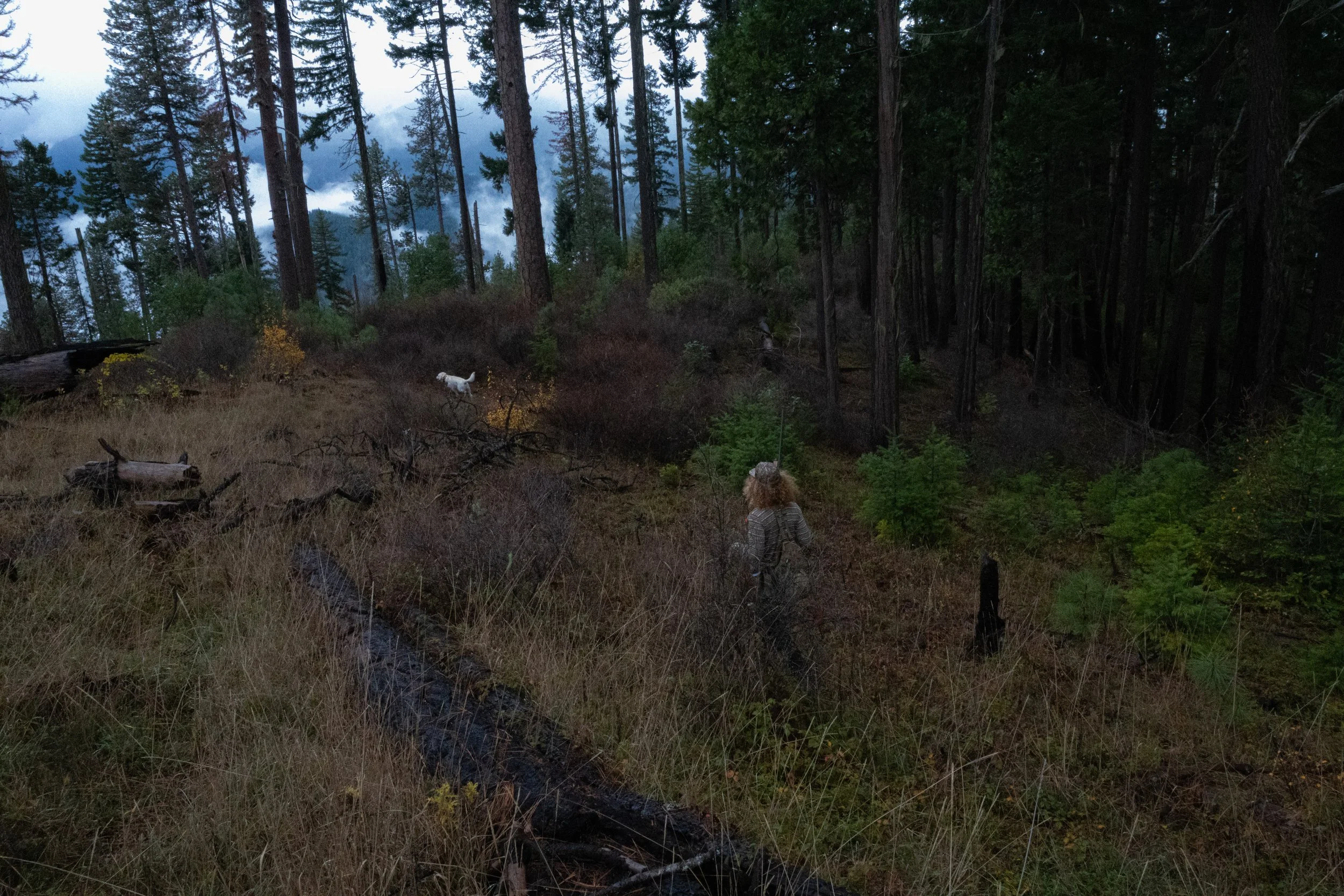
The search continues
Oregon has two species of quail distributed throughout the state. We are fortunate enough to have both types on our western slopes: valley quail, or California quail, are smaller and generally inhabit lower elevations found in the valley. Mountain quail are larger and live up to their name, making their home in much higher elevations on ridges, glades, and recently logged areas in the mountains. The large coveys that quail form make tracking “singles” or individual birds easier after the initial flush that breaks up the group. This is also a double edged sword, as it is difficult to pick one bird as a target amidst the chaos of five, ten, or even twenty birds flushing in close proximity to you.
The Oregon Department of Fish and Wildlife also plants farm-raised ringneck pheasants in several locations throughout the valley for sport. These early season plantings provide consistent, close to home opportunities to practice on an introduced species. Many new hunters take advantage of this. It also is popular for new bird dog owners to train their dogs on birds in the field. Pheasants, unlike our native upland species, prefer agricultural fields on the valley floor. If you’re hoping to chase truly wild pheasant, you’ll need to jump the Cascades and head east, where things are drier and there is an abundance of ideal agricultural habitat.
If you’re hoping to get into hunting for upland birds, be prepared to walk. Excursions often involve hiking great distances, probing suitable habitat for the birds. It is not uncommon to walk five, ten, or even fifteen miles in the search for birds, generally with the help of a hunting dog. Because of this, it’s beneficial to be an active person in good physical shape, as is the case with most outdoor activities. If you’re not ready to climb steep hills, pheasant and quail hunting in flatter environments does not require the strength and conditioning that you may otherwise need to climb along a mountainside, providing easier access to the sport.
We are surrounded by incredible access to public land in both mountain ranges that create the edges of our Willamette Valley. Grouse are edge-loving birds, and make their homes on the terrains transitional features. This may be the edge of a glade, edge of a logging road, edge of where deciduous trees meet coniferous ones, the edges of recently logged or burned land, or the edge where new forest meets old. There is an overwhelming amount of habitat available to us in the valley, which makes picking and choosing where to go one the most difficult parts. Overgrown, abandoned logging roads make especially great habitat for birds. Finding an area you are comfortable with is a great starting point, as you can return throughout the season and learn the birds’ behavior. Early season birds will be found near water and food sources like plants seeding out and berries. Later in the season birds feed on new growth, alder stands, and tight groups of young firs that they use as cover from inclement weather. Mountain quail can also be found in the habitat mentioned here, however, both types of quail prefer more open areas. Bottom line—you need to explore your local habitat to find birds. Generally, this will often look like driving logging roads until you see birds and making a mental note to return.
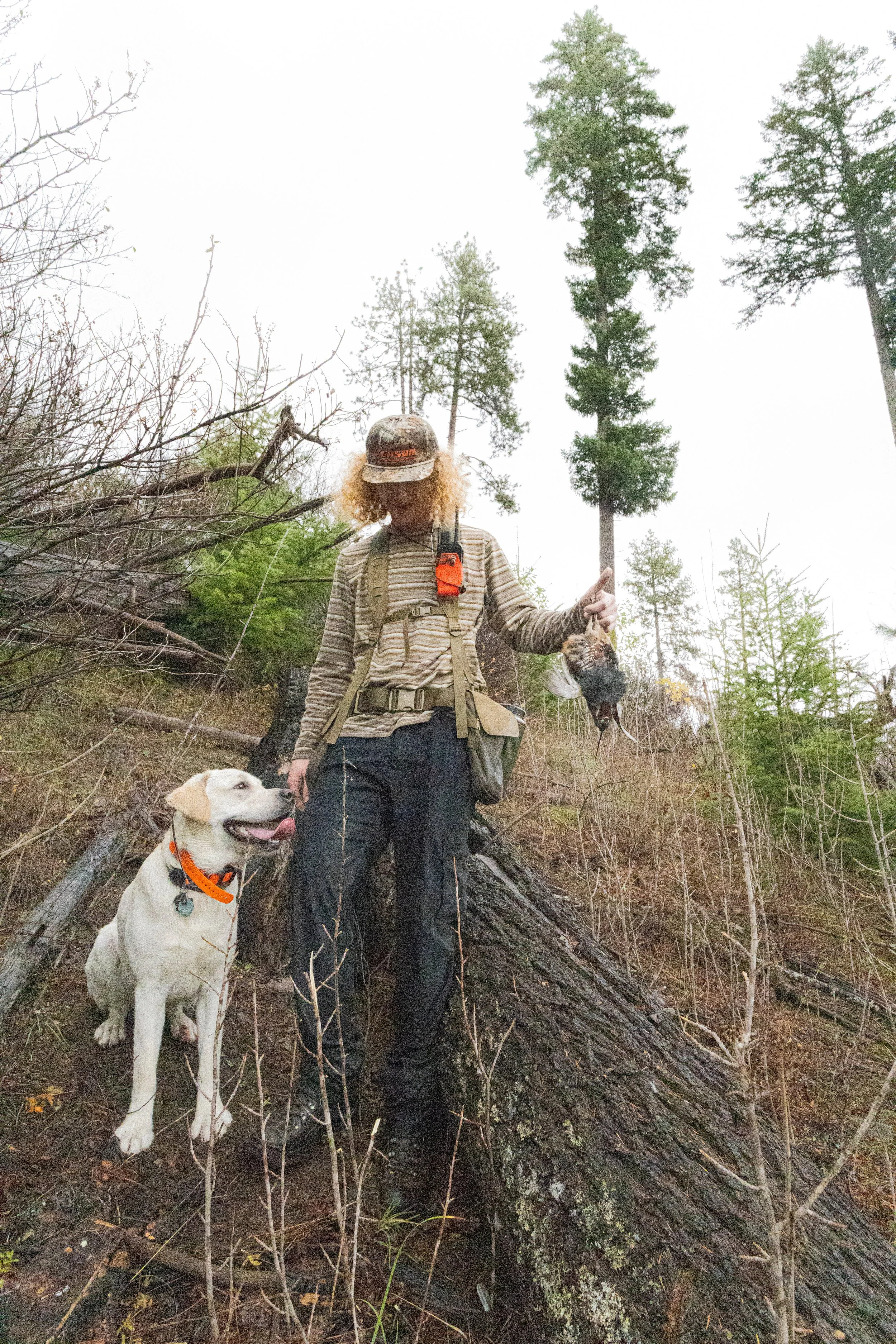
A man and his dog (and an upland game bird)
Grouse and quail have to fill their gizzard with small rocks or “grit” to aid in digesting hard bodied seeds and fruits. They must do this multiple times each day. We are lucky to have a maze of logging roads through our forests that provides birds with miles of road to acquire their daily grit. Generally they do this in the mornings and evenings, so driving our logging roads is a great way to find areas where birds live. Grouse and quail will hold tight in their cover and often flush just feet from where you stand. The thunderous beat of their wings will startle you, and often, by the time your gun is mounted, the birds vanish into our thick forests. This is where bird hunting dogs come into play, Although it is not impossible to upland hunt without a dog, it is extremely helpful to have some notice that birds are in the area prior to their flushing. Pointing dogs are the ideal dog breed type for this type of hunting. Trained dogs will go on “point” or freeze in the direction of birds, giving you some notice that birds are nearby. This gives you time to get ready, and give them their release command which sends them barreling into the cover where the birds are holding. After downing a bird, dogs also can aid in retrieval. The bond between dog and hunter is deep, and they work as a team to have a successful hunt. The joy and satisfaction of a bird dog working in the field is more than any toy, bone, or treat at home could bring it.
A typical day hunting quail and grouse in the valley means hitting the road early and heading toward the mountains. For those with some experience, it means returning to previous haunts which have held birds in seasons gone by. If you hunt with a dog, it means working as a team while probing suitable habitat. Once birds flush, having a dog makes flushing birds a second and third time more viable. Upland hunting also requires a keen eye and a perceptive mind. Seasons change, bird behavior is unpredictable, plants grow and change the landscape, while suitable habitat in past years grows out and is suddenly too big. A typical day involves many lessons from mother nature to the perceptive hunter.
Upland hunting shares space with many other outdoor activities, like fly fishing and mushroom foraging. Where you find one, you’ll often find the other. Fortunately for those who don’t bag a bird, the upland season overlaps with the picking season for many fall and winter mushrooms. We are blessed in the valley to be able to pick chanterelles, boletes, hedgehogs, and more during our bird season to supplement the feast these birds occasionally bestow upon us.
There is also some overlap with the sport of fly fishing—any fly tier knows this. Upland hunting shares an aristocratic upbringing with the sport of fly fishing, and many of the feathers on various upland game birds are used in the art of fly tying, or manufacturing artificial flies on hooks for trout fishing using fly rods. Feathers from all upland bird species in Oregon are readily utilized by fly anglers to make flies to fool finicky trout. Many anglers consider catching a trout on a fly you created a milestone. The ultimate achievement might be to catch a trout on a fly that you have tied using feathers from a bird you harvested.
Upland bird hunting generally contains a certain degree of reverence and integrity that other disciplines of hunting do not always have. Upland hunters, like fly anglers and mushroom pickers, are lifelong students of their environment. They benefit from carefully examining their surroundings and learning from it. This creates individuals invested in being stewards of the land, and placing a high importance on education and conservation. While a day out upland hunting may not always yield a bird in your game bag, it will always leave you with a clear head and a sublime feeling of your place in nature.
Find Simon Stephen online @fly_goddd on Instagram!