
Brother from the Sea
It is nothing short of miraculous when young Humpback whales, born in the warm waters off Mexico, survive the gauntlet of the West Coast migration. They cling to their mothers for protection from killer whales who lie in wait each year for the arrival of their drifting feast. The journey is fraught with danger and uncertainty, and yet it is a wonder each time they finally reach their feeding grounds in Alaska.
A few weeks ago, a two-year-old Humpback whale washed ashore less than two miles from our home. His voyage north was cut short by heavy ropes and crab pots, a burden that rendered him unable to move in open waters. He was alive, otherwise healthy. Locals rushed in with dogged determination, cutting away the crabbing gear, forming bucket brigades to keep his massive body wet. The crowd waited with hope for the tide to carry him back to sea. The persistence of locals was extraordinary, yet it was a numbers game: the angle of his body, the height of the tide, and the weight of his 8,000 pounds.
Few boats had engines powerful enough to tow him. Even if they did, the strain on him could cause irreparable harm. Without buoyancy, his organs would begin to collapse under their own weight. Humpback whales, feeding in the middle depths, are especially vulnerable. Their migratory paths and middle-depth range often see them entangled in ropes, struck in shipping lanes, caught in drifting debris. Other species of whales feed nearer to the surface or closer to the ocean floor, making them less exposed to such dangers.
For two days, I resisted going, afraid of what I might feel. I told myself I did not want to be a look-y-loo hovering over a dying creature, but the truth was I wasn’t ready to face my own emotions. My inner voices battled until one finally prevailed, “This is a once in a lifetime experience you need to see.” While I waged my private internal conflict, the young whale had deteriorated rapidly over the last twelve hours.
News reports said he had moaned through the night. I knew that sound would be my unraveling. When I arrived midday on the third day, he was smaller than I had imagined, lying so still I thought death had already claimed him. Then I saw it—the slow rise and fall of his breath, revealed by the late fall sun glinting on his wet skin. A sudden tail slap, a lifted flipper—gestures of life in his final hours.
Gatherers stood in silence behind yellow tape. No loud voices, no raucous laughter. The crowd carried a reverence for being in the presence of this great creature. The Sheriff’s department, the Forest Service, volunteers from Seattle, a veterinarian flown in from California, the young woman standing next to me, from Salem—all spoke in hushed respectful tones. The veterinarian had given a shot to relax the youngster, the prelude to euthanasia.
In a moment, the air shifted. An incoming haze descended on the beach and softened the edges of everything. Drumbeats sounded in the distance, slow and steady. Something ancient drifted on the wind with each beat. Four men from the Siletz tribe stood in vigil, drumming and singing at the whale’s side. Emotions, long buried, clawed their way to the surface, lodging in my throat. Tears that had dried up years ago became wet again, giving life to emotion. I had closed off too much of myself, mistaking hardness for survival in a time of ugliness. The send-off, this collective awe for a brother from the sea, shattered my defenses. Light began to escape between the shards.
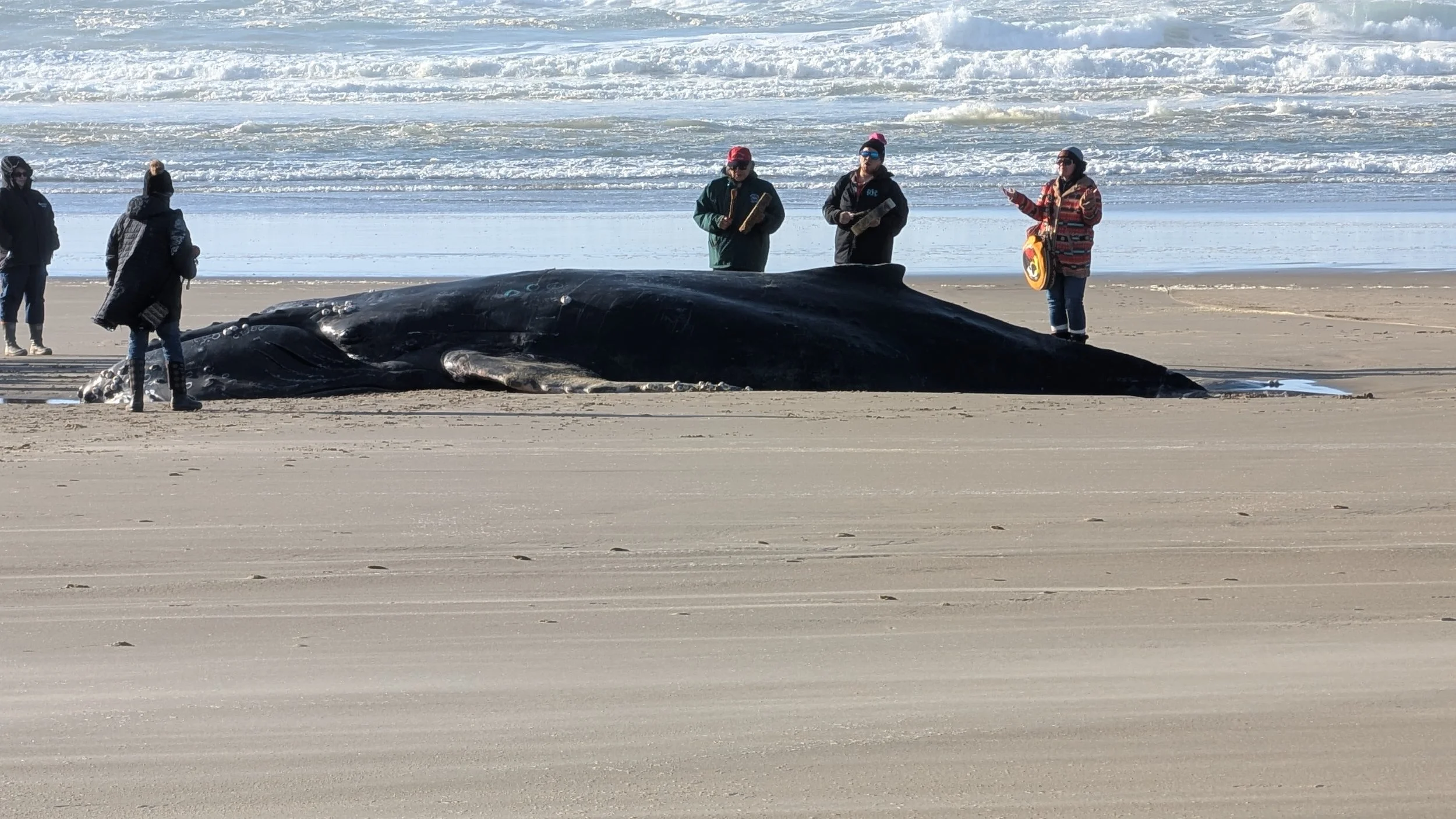
Four men from the Siletz tribe stood in vigil, drumming and singing at the whale’s side
Just as I felt I might drown in the merging of grief and exquisite sweetness, three women of the Siletz tribe began singing in their native tongue. Their voices rose soft and gentle yet seemed to pierce through time itself. They were singing the whale home.
My healing came as a surprise, born in the hushed reverence away from the noise of the world. Together, on the beach that day, we honored the passing of that majestic being. I had stumbled into that sacred intersection when life and death intertwine and briefly become one.
I am reminded how bittersweet life is—how beauty is not separate from heartache. A shared thread runs through every living thing, binding us, connecting us, sustaining us. Sometimes those reminders slip in, quietly, waiting for the perfect opening. Other times, we must look into the black hole of grief to glimpse the cracks of light.
Thank you, brother from the sea, for touching my life and opening my heart.