
Rookie Reflections on Mount Washington: 16 miles. 14 hours. 12 climbers. One amateur.
My alarm woke me up at three thirty in the morning. Tired and groggy, I rolled out of bed to grab a cup of coffee that earlier I had programmed to brew for a few minutes before. It had been a restless night in bed; I had tried to go to sleep around nine o’ clock, but all I did was toss and turn. As I packed the last of my things into my 35 litre pack, I wished to myself that I had slept better. It’s always hard to sleep when you’re heading out on an adventure the next day, though, and this was going to be a big one for me: I was climbing Mount Washington on my first-ever mountaineering trip.
A few months earlier, I had met a steward of a local outdoors club called the Obsidians. Founded during the 1920’s, this club of adventurous souls have been teaching mountaineering and rock climbing skills to groups of outdoorspeople nearly every year since it began. This is only a small part of what they do; one day, they’ll be getting their own story in this magazine. I signed up to be an Obsidian member almost immediately, and soon after decided to sign up for the Climb School. I had always wanted to learn more about mountaineering and give it a shot, and this was going to be my chance.
The course takes place one day a week over six weeks, and time is spent evenly between mountaineering and climbing skills, many of which I used during the trip I’m about to tell you all about. They included basic climbing knots like the prusik. The prusik knot is what’s known as a friction hitch; a loop of rope that can be moved freely up and down another rope, but catches when under tension. We also learned how to use an autoblock, another piece of safety gear that serves as a friction hitch while rappelling down off a ledge. We learned about personal anchor systems (PAS), moving as a rope team, how to pack for a trip into the backcountry, calorie to weight ratios and how to use them to your advantage, proper training, and much more. Much of this was new to me, but I was trying my best to soak it all in. We also got some hands-on experience, taking what we learned and applying it outside a sno-park near Hoodoo Ski Resort and again at the local rock climbing spot in Eugene, the Columns. By the time the class was complete, I felt ready to give my mountaineering dreams a go.
At the end of each Climb School there are typically two climbs that you are given priority to join: Diamond Peak and Mount Thielsen. I quickly signed up to use my snow skills on Diamond Peak that April, but bad weather forced us to reschedule to a time that I could not join. Disappointed but undeterred, I signed up for a climb on Mount Thielsen. But, two days before we were set to climb, a fire broke out at the trailhead. Eventually, that fire would spread and burn over 80,000 acres. After the second climb fell through, I was bummed out. Ever since my schooling, I had been practicing rock climbing inside and outside regularly. I was also hiking seven to twelve miles a few days a week on Mount Pisgah. I was in hiking shape (at least I thought I was), and ready to put my new skillset to the test. What I didn’t know at the time was I’d get that chance on a mountain I wasn’t expecting to set foot on for a while: Mount Washington.
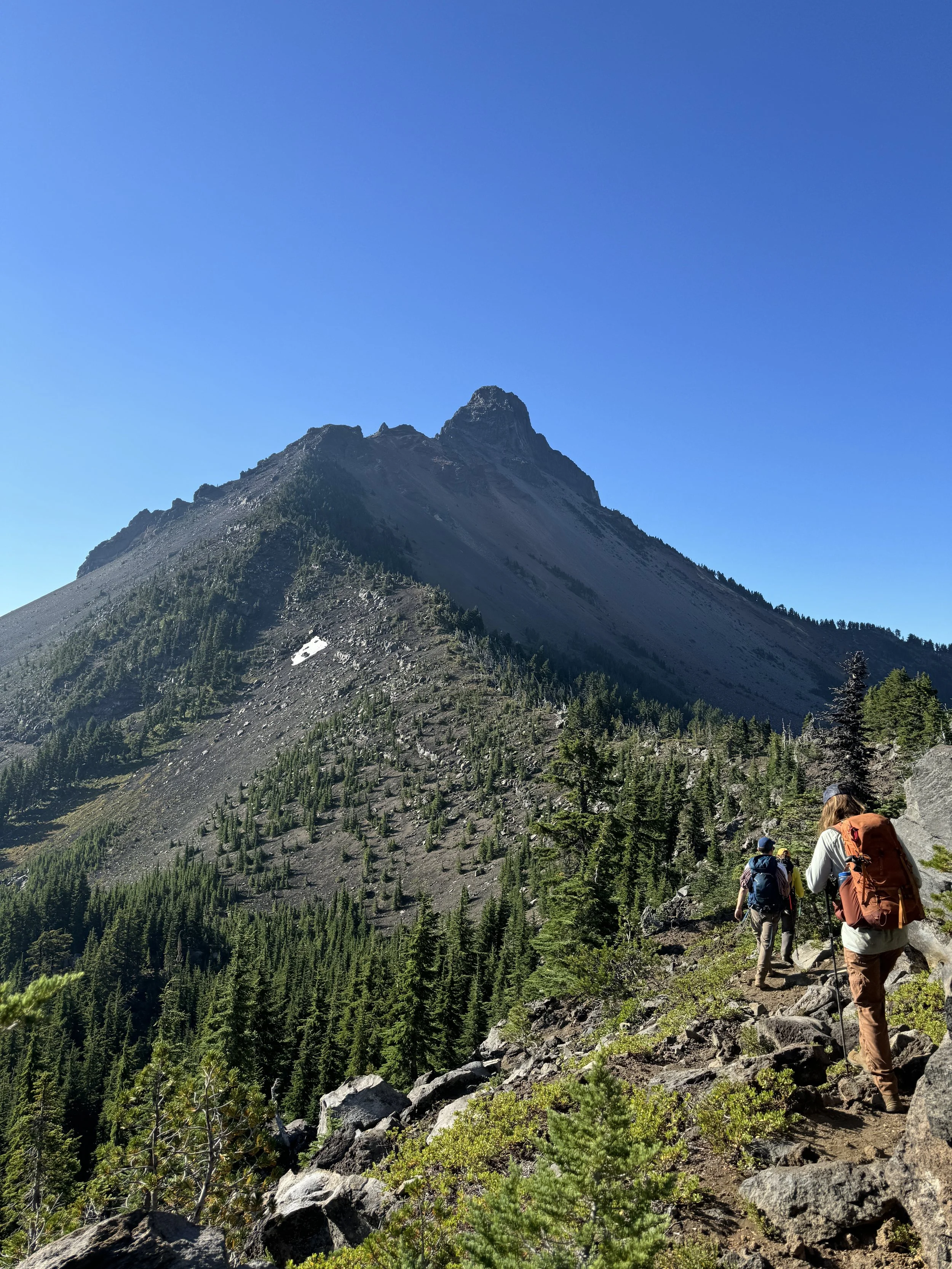
The approach. Photo courtesy of the editor
Mount Washington is a deeply eroded volcano, the remnants of which stand at 7,798 feet. At the top is a volcanic plug, a summit block made of a hardened piece of magma that rises approximately 300 feet and requires rope climbing to safely ascend. I hadn’t done the graduation climbs, but I was feeling good and ready for a trip; it couldn’t be that different, right? I saw sign-ups for the climb go up in July, but missed the day it opened. Forced to join the waitlist, I assumed I wouldn’t be joining this trip either. But, just two weeks before it was set to happen, I received an email letting me know I’d be going.
The group totaled 12 members, including our three guides. A woman named Danni was our lead guide, and was joined by Jamie and Sheri, climbing partners who were new to the Obsidians but had significant mountaineering experience. They climbed Rainier a few months after this story. All three were exceptional mountain climbers, and Danni was highly experienced with this climb. I can’t remember how many times she said she’d done it. She is also a part of Eugene Mountain Rescue, and overall an absolute badass in the local mountain climbing community, as I’m sure both Jamie and Sheri are now as well. Danni had camped near the trailhead the night before, and most of the rest of us met at 4:30 that morning in an Albertsons parking lot in Springfield. From there we carpooled up the McKenzie Highway. We arrived on the road to Hoodoo, but took a left near the entrance and headed down a dirt road towards a trailhead for the Pacific Crest Trail, or the PCT, where we would begin our approach. In the distance was the silhouette of our goal, and as we neared the trailhead the morning light began to illuminate the many faces of the old volcano.
We began hiking around 6:30 through a burn along the PCT. A massive fire had moved through here years earlier, and the trees still bore the scars. There was still some shade, and my spirits were high. I chatted with our guides and a few of my friends who I had made during climb school, Sam and Michael. It was a few miles into the PCT where we’d turn off onto the climbers trail, which would take us to the ridgeline where we’d work our way towards the summit. Once we were off the PCT the trail got steeper, leading us up a series of switchbacks towards the ridge. I was doing alright, but by this time I had started to make a big mistake that would eventually cause me some grief: I wasn’t eating or drinking unless we were stopped. I’m a bigger guy, and the calories I didn’t take in during our hike up the ridge had a big effect on me as the day went on. I was losing water fast as well, and would have benefited from drinking more. In general, I wasn’t taking in enough to keep my energy levels up, even when we were stopped. And as we neared the ridgeline, I could feel myself starting to lag.
Once atop the ridge, I could see Mount Jefferson and Three Fingered Jack; it all felt subalpine and I loved it. It was beautiful, but I was getting tired. The ridge pitched up and down, and it was getting more difficult for me to maintain my pace. Try as I might, I just couldn’t seem to keep up. I’m a slow walker in general, but I truly believe my lack of energy can be attributed to my calorie counting errors. As we neared the volcanic plug that made the summit of the mountain, we had to make our way around a large curve in the ridge that brought us underneath a massive wall of rock. Slowly stepping across talus and choss underneath, we made our way around the chunk of mountain until we reached the point where we would begin to work our way up to the staging area of the climb.
Coming around the bend, the reality of what I was doing set in as I caught my first glimpse of the summit block. It was a hulking block of rock, shooting straight up from the terminus of the ridgeline. From the top, we could hear shouting. A local outdoor youth group had left earlier than us that day and had already ascended, and was now preparing to rappel down. They moved above us on the summit block, creating occasional rockfalls. I watched bits of the mountain the size of baseballs come barreling down from 150 feet above into the scree field below, exploding and hurtling down the face. It’s something that people can explain to you about what happens during these types of adventures, but you won’t really understand how spooky it is until you’re there.
The last obstacle before the summit climb was a scramble through a narrow path up to where we would prepare to climb. I was in the back of the line watching each person before me make their way up slowly, mashing themselves into the wall as rockfall from above was called out. Finally, it was my turn. Jamie was kind and pushed me on, and I mustered the nerve to start. Halfway up, as I inched my way out of the slot, a rock fell that I didn’t see. “Rock, rock, rock!” Someone called out, louder than the previous times; it must’ve been pretty close. Suddenly, Jamie yelled for me to get back, making me realize that maybe it wasn’t just close, but coming right at me. I fell to my stomach and pushed on the loose rock below and scrambled backward, where Jamie grabbed me and pulled me out of the opening.
I never actually saw the rock, but according to the folks above me it had come down the small slot, hitting the person above me on the top of their pack. I have no idea how close it had come to me, but I’m glad I didn’t wait to find out. When I stood up, having escaped what I assumed would’ve been a nasty hit, I saw one of my fingers had been sliced open on the way down; not ideal for climbing. And worse, I was at the bottom of the bottleneck again! Tired, dusty, beat up, and running on adrenaline, I slowly made my way up and out of the narrow corridor and to a flat spot underneath the base of the summit where the other’s had been waiting. It was here where I felt my first true bit of fear about what I had gotten myself into. I was gassed, bleeding, and had used the last burst of energy I had to push myself out of the slot, and before me now was the final leg of the journey: a 300 foot rope climb to the top.
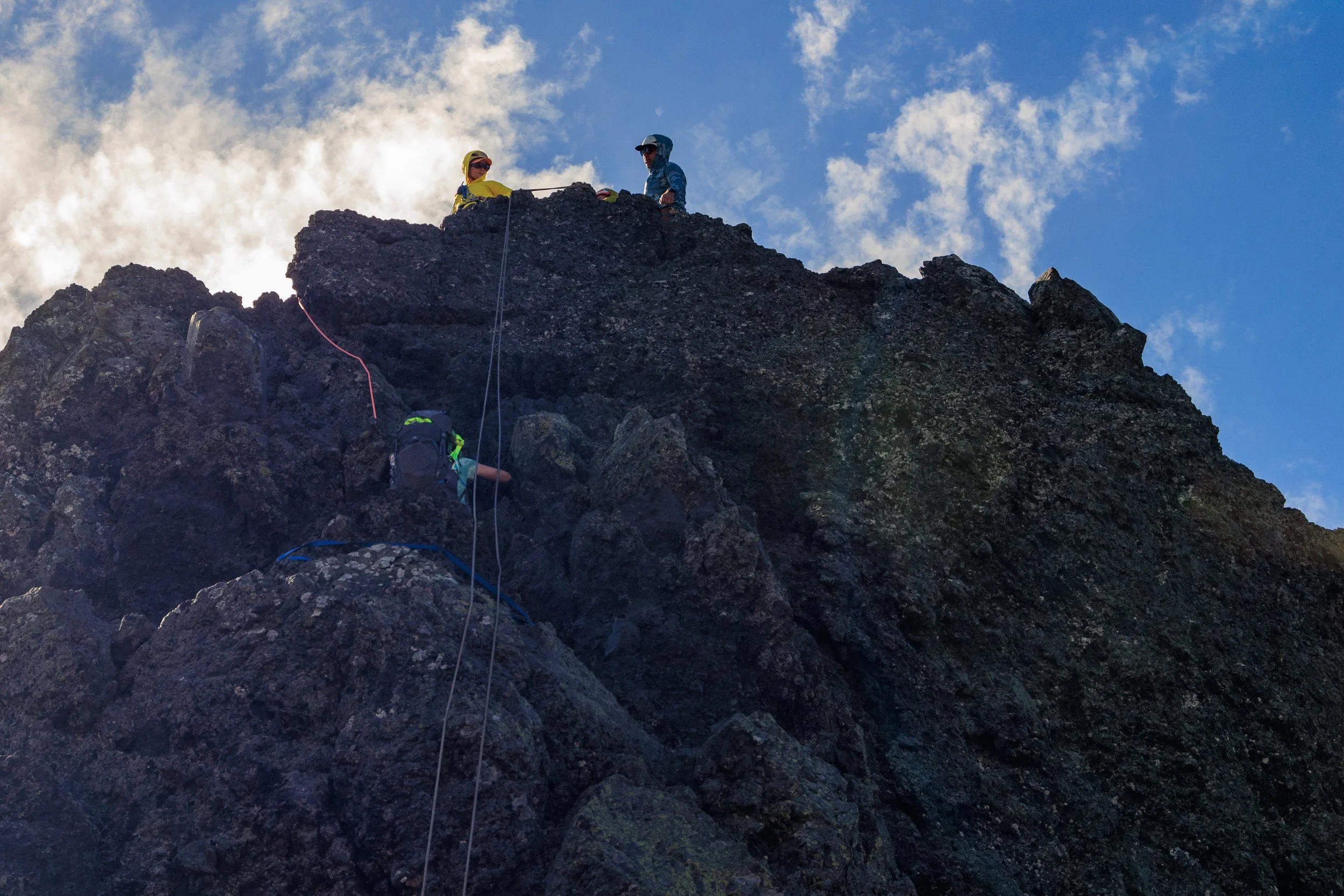
Guide Jamie nearing the crux move. Photo courtesy of the editor
Looking up, I nearly cried. I was exhausted and nervous, and started to have second thoughts about trying to make it to the top. Danni even gave me an out, the understanding leader that she was. I had to make a decision about what would happen next, but I was also in luck. The group above us was large, and we were still setting up gear to prepare to climb. The group leaders had also agreed to alternate between the groups who were descending and ascending, meaning it would be a while before it would be my turn to go. My hands shook from lack of calories, and as I drank some water Sheri passed me an electrolyte pack called a Squelchy. It’s something I hadn’t thought to bring, but now that I understand their usefulness I don’t leave home without them. I sipped it straight from the pack, and mixed another into my water. My energy began to recover, and while the minutes passed I began to make up my mind. I could make it to the top. While Danni had been preparing to set the ropes up for us, she had explained how it would go. It was around 300 feet to the top, and our route consisted of three sections. The first and third were fixed lines that we would prusik up, while the second was more of a guideline we could use to navigate the terrain. After an hour of waiting, it was my turn to begin the climb; I tied my prusik onto the first line and began moving. “Climbing!”
The first section was straightforward, with a gradual slope that eventually became more vertical. This section also held the crux of the climb near the top of it. It was just a slight overhang, maybe a 5.7 that required only two or three moves, but I was wearing Keens, had opted to climb with my backpack to bring camera gear, and the move was about 75 feet off the ground. For me, it was intimidating. I picked my way up to the crux where I stopped and assessed. I found a handhold. Then another. I placed one clunky hiking shoe on the wall, then the next. I lifted up and over the overhang and breathed a sigh of relief. That little success changed something for me mentally. I was still scared, but I was in control. I looked out and saw the valley stretch along the horizon for miles, and knew I could make it to the top.
I continued up, making my way to the guideline in the middle of the sky. I detached my prusik and began to move, holding on to the rope with a strength I thought I wouldn’t be able to muster. I controlled my breathing as I moved along the edge of the rock until I arrived at another big move that was near vertical. Below it was a 30 foot slope and a cliff that fell to the bottom of the summit block. For this, I decided to prusik in, because I couldn’t shake the thought of slipping and falling to my demise at the end of that slope. I didn’t know it at the time, but other climbers were using their personal anchor systems to stay attached to the rope; I was just freewheeling it up there totally alone. No harm, no foul, thankfully.
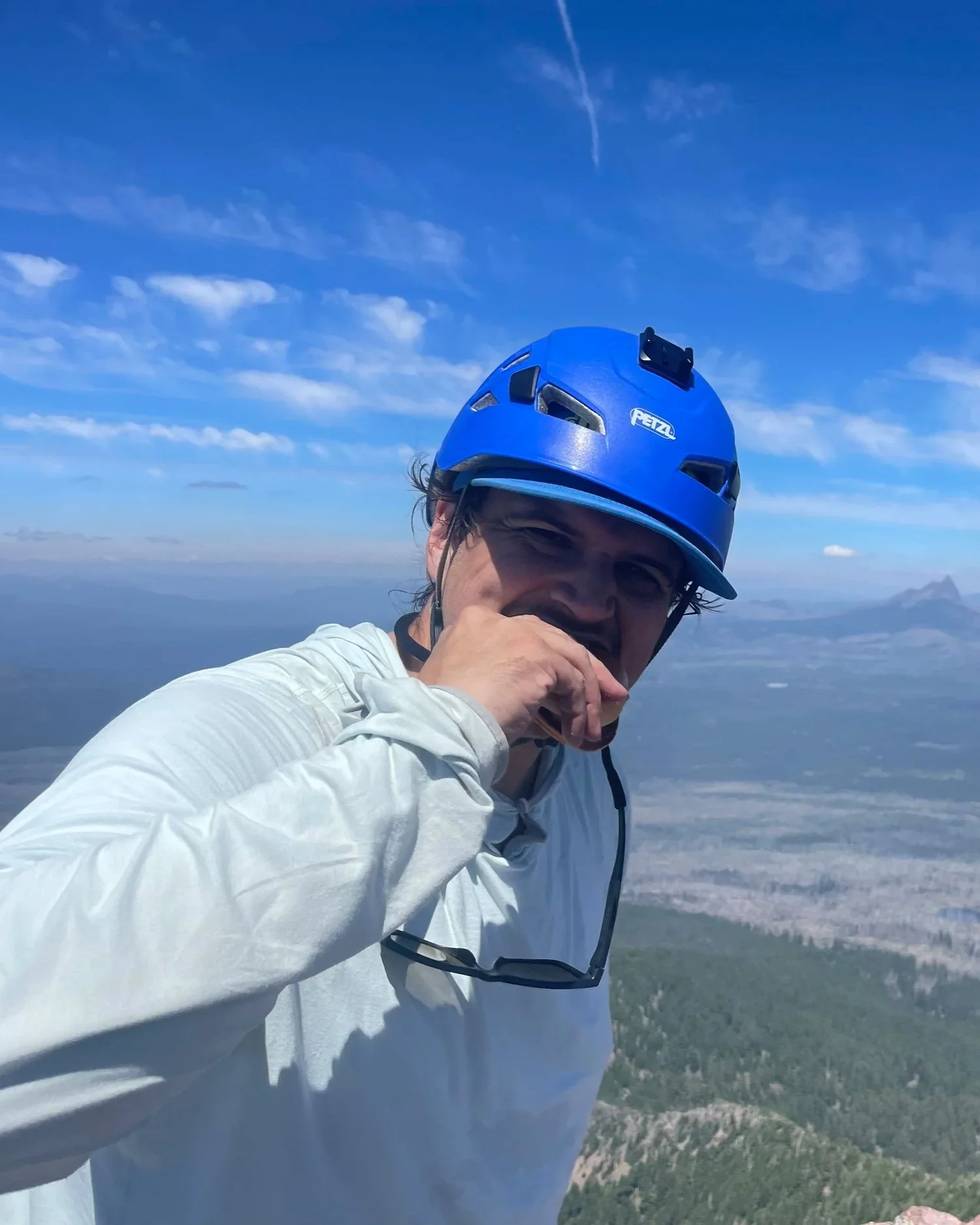
Photo courtesy of the editor
I moved slowly (and even got passed), but eventually I made it to the third and final section of the climb. I could feel it now, and my nervousness was beginning to be replaced with excitement. The third section was the easiest, and as the verticality of the rock started to recede I knew I was almost there. With one final heave my head peaked up over the top, where I saw three other climbers not with our group looking at me. They welcomed me and congratulated me for making it; I thanked them and made my way to my group, who were near the small rocky spire that marked the official top of the mountain. I sat down again and looked out. In the distance, Mount Jefferson, Three Fingered Jack, and Three Sisters loomed large in the smoky haze from August fires. Between those peaks and the one I stood on were miles of valley floor. It was a beautiful view, one that I’d never seen anything like before. Sitting at the top, feeling the wind blow across my body and looking out, I truly understood why people dedicate their entire lives to climbing mountains. I thought about the things I had done to make this climb, and was proud to have succeeded. While we rested, I took photos of the group celebrating on the summit spire. Someone pulled out of the rock an old ammo box containing a log book. I signed it along with the Obsidian’s own summit registry, a waterproof journal they use to keep track of who’s done what and when. I also took the time to eat something I had added to my pack that morning for the occasion: a cheeseburger from McDonalds.
Although the climb was complete, we were only halfway done. Next up was a 300 foot rappel to the bottom. I had practiced my rappelling skills at The Columns in Eugene for a few days before the trip; I was confident, but also nervous about doing it in a less-controlled environment. The rappel would happen in two parts, each about 150 feet. The second required starting from a squatted position and extending your butt out over the edge until you were in the proper position. If you stood up, the anchor would slide off the short, pyramid-shaped rock it was built on. I had never seen anchors in the wild before, and I remember staring at all the spent webbing around the rocks, wondering just who it was that had been up here before me. The rappel went fairly smooth; the first half was no problem at all, and I managed to stick my butt out over the abyss the right way when I began the second half of the descent. I did, however, manage to get myself stuck about 50 feet from the ground when my autoblock locked up. I had wrapped it too many times around the rope, and it had cinched up in a way that made moving nearly impossible. I fought the autoblock until I found a safe(ish) spot to untie and reattach the piece of safety, at which point it was smooth sailing to the bottom.
We were all down safe, but there was bad news. The delay we had experienced on the ascent while we took turns with the group above was significant, and now we were running out of daylight. Danni, Jamie, and Sheri discussed while myself and the group looked on, and it was decided that instead of taking the ridgeline back the way they came, we would descend via a scree field on the northeast face back to the PCT, saving us a large chunk of time. It was a good idea, but the scree field was huge, stretching from below the summit block nearly down to the treeline. We started slowly, stepping carefully on the shallow, loose surface in an attempt to keep from slipping on the sharp rock. Most of us failed in this at least once, falling on the rock while trying not to spill it onto group members below us. The scree got deeper and looser, and navigating downward became more and more difficult, until Danni introduced the group to “scree skiing.”
Scree skiing is done on steep pitches with deep, loose rock. Instead of trying to find your footing as you move, instead you drive your heel in and let the rock slide underneath. Then, as if you were walking, you do the same with your other foot. In this manner, you begin to “ski” down the pitch. After it was explained to us, the exhibition began to fly down the face at great speed. It was incredible! 12 people in a line, floating down the side of a mountain. We must have scree skied for over a mile, until finally we managed to reach the treeline and more solid ground. In this place, surrounded by large boulders and tall pines, I took one last look back at the mountain I had just climbed. The moon was rising from behind its summit. I took a breath, then turned and followed the group into the trees below.
For the next few hours we walked between dense tree stands and open fields laden with the remnants of early summer wildflowers. It was a beautiful walk, one I would’ve enjoyed thoroughly if I hadn’t been experiencing swelling in my ankle. It was causing me to walk in an odd way to try and keep weight off of it, and the further we went the worse it got. My foot burned with each step, but I couldn’t think about that; the car must be close and once I got there I could rest. The trees began to look the same and we entered the burn we came in on from the PCT. Each turn gave me hope that we had arrived back at the vehicles, only to be met with the same scene I had just passed. To be honest I started to feel a little crazy. The light of day was fading and the rows of burned pine trees never ended. But, finally, after 14 hours, 16 miles, and a 300 foot rope climb, the white of my Subaru popped out in the distance. We’d made it back.
The end of the trip felt good, even though my foot felt like it was on fire. The guides shared fruit with us they’d brought for the occasion, and a sticker was given to us with a drawing of Mount Washington on it for our efforts. I keep that inside a box of keepsakes in my office space now. Eventually, we all headed out in different directions. Some folks stayed the night, opting to go for a dip in a nearby lake, but I needed to head home. I’d scratched an itch I’d been feeling for years, I was totally exhausted, and I was ready to take a hot shower. When I did get home, I told my partner about the ordeal. The ups, the downs, and everything in between. I told her I’m not sure if I’ll ever do anything like that again. But, she knows me well. She responded, saying “why don’t you wait until tomorrow and let me know if you still feel that way.” And wouldn’t you know it, she was right; I could do it again someday.
Looking back on my journey up Mount Washington, I can say without a doubt that while I felt ready, there were many things I didn’t know about mountaineering that I do now. It takes dedication, a very specific skill set, and time, the latter of which I have very little of these days. I do plan on going on another climb again soon, when that itch pops up again. And when I do, I’ll be better prepared to take it on. I’ll be stronger, I’ll eat more, and I’ll pack lighter; with room for a summit cheeseburger, of course.
Read more stories from the mountains
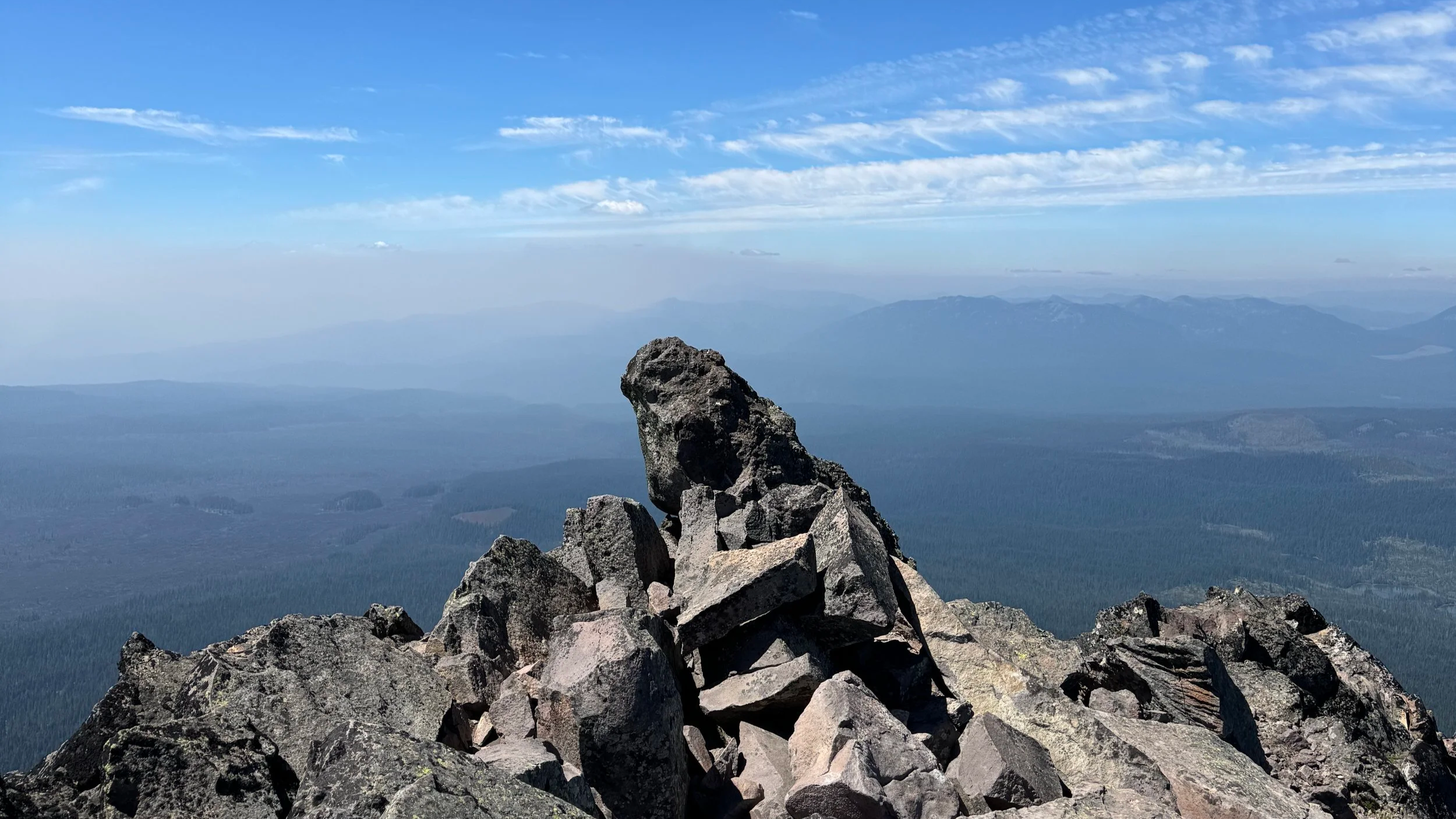
The top of Mount Washington. Photo courtesy of the editor