
Somewhere Between Holding On and Letting Go: A Journey Down Oregon’s Owyhee River Reveals the Quiet Power of Place, Partnership, and Acceptance
There are places that ask something of you the moment you arrive, not through words or signage or even difficulty, but through presence alone. The Owyhee River is one of those places. It does not ease you in or offer orientation. It does not try to be known quickly. Instead, it asks for attention, for patience, and ultimately for a willingness to be changed by it.
Reaching the Owyhee is its own quiet initiation. The drive stretches long across southeastern Oregon, past the edges of familiarity and into a landscape that feels deliberately spare. Sagebrush plains roll outward in muted tones, interrupted only by wind and sky, until, almost without warning, the earth gives way. The land opens into canyon, and the river appears; not as a spectacle, but as something revealed slowly and without explanation.
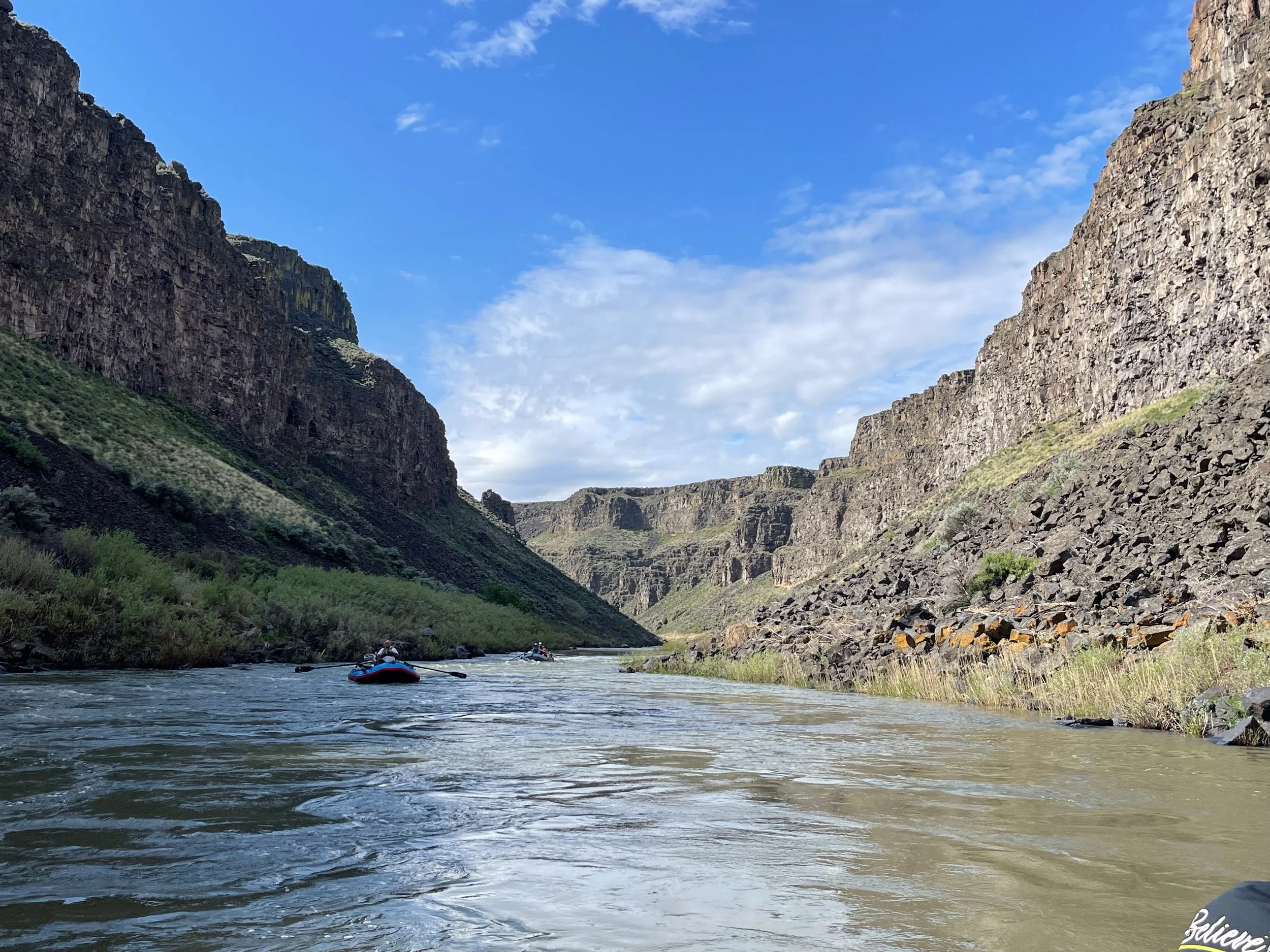
The Owyhee River begins far beyond what most people see; rising in northern Nevada, flowing through Idaho, and carving its way into Oregon through a system of deeply incised canyons shaped over millions of years. The landscape here is the product of immense volcanic activity tied to the Yellowstone hotspot, where repeated basalt flows blanketed the region and were later carved by water into the canyon system that exists today. What remains is a place defined not just by depth, but by time; layered, exposed, and still in motion.
Even its name carries a story of distance and loss. “Owyhee” is an early anglicized spelling of “Hawai‘i,” named for Native Hawaiian fur trappers, then referred to as “Owyhees”, who were brought to the region in the early 1800s and never returned. Their absence marked the landscape, and their presence remains embedded in its name. It is a reminder that this place, like so many others, holds histories that are not immediately visible but are no less real.
Long before that, these lands were, and remain, part of the ancestral territories of Indigenous peoples, including the Northern Paiute, Shoshone, and Bannock. The canyon, the river, the surrounding high desert carry cultural meaning that predates any modern recreation. While much of that story is not mine to tell, it is impossible to move through a place like this without feeling that it is more than scenery. There is a presence here. A kind of quiet intelligence. Not something mystical in a performative sense, but something grounded in recognition that this landscape holds memory, and that moving through it requires a certain level of humility.
Often referred to as Oregon’s “Little Grand Canyon,” the Owyhee resists comparison. Its basalt walls, rising 500 to 1,000 feet above the river in layered volcanic formations, carry a gravity that does not rely on scale alone. Standing at the put-in at Rome, looking downriver into the canyon, the feeling is not awe in the conventional sense. It is something quieter and more disorienting; a recognition that you are entering a place that does not adjust itself to you.
We launched in early May, within that narrow seasonal window when the Owyhee becomes navigable but still demanding. Flows hovered between 1,200 and 1,300 cubic feet per second, low enough to expose the river’s technical character, high enough to keep us moving. The Owyhee is often described as a “guide’s river” for this reason. Its window of travel is brief, its conditions variable, and its disposition dramatically changed with water level. At these flows, there would be no room for complacency. The river would require precision, attention, and a kind of sustained presence that does not allow for distraction.
Our group reflected that same sense of uncertainty and commitment. There were eleven of us in total, but familiarity was not the defining feature. I only knew about half of the crew. The rest had come through an open call for paddlers from our trip organizer. We were a rag tag group of enthusiasts willing to step into a multi-day expedition with people we’d never met, trusting something worthwhile would come from saying yes.
It was, in many ways, a gamble.
From the moment we began rigging boats at Rome, there was an underlying sense that this trip would not be shaped by how well we knew each other at the outset, but by how we showed up when it mattered. While I had chosen my team, only one had any experience rowing, and the other was a strong paddler, so we were a group of three, in a 14’ raft with a stern frame.
About a half mile downstream from the put-in, the river made its first demand. A low head dam, formed not by engineered structure but by accumulated rock and debris, spanned the entire channel. It was subtle enough to underestimate and forceful enough to stop a loaded raft without warning. The kitchen raft, one of the heaviest boats in our group, piled high with extra gear, hung up squarely on the obstruction.
Immediately, our crew sprang into action. One by one, we ferried our boats to shore, just below the dam, clambering across slick rocks with rescue ropes in hand, and began the teamwork of problem solving to set it free. There was no formal discussion about roles or responsibility. Everyone moved into action and fell into place. Rigging the ropes onto the raft for leverage, we pushed, pulled, shifted weight, adjusted angles, and worked together until the raft finally broke free.
In that moment, we ceased to be a collection of unfamiliar individuals and became something more functional, more connected. The Owyhee had introduced its first lesson: independence has limits here, and cooperation is not optional.

Reflection on the river. Photo courtesy of Carrie Mizejewski
Progress on the first day came slowly. Strong winds pushed against us, at times stalling our forward movement entirely. What might have been a straightforward stretch became a study in persistence, and by late afternoon, it was clear we would not cover the distance we had anticipated. We made camp at Lower Fletcher, somewhere between 9-10 miles from our put-in. The site offered everything we needed. Cottonwoods lined the upper bank, leaves rustling with the breeze, opening up to a perfect beach overlook while the river moved steadily past in quiet contrast to the effort of the day.
It was in these quieter moments that the broader purpose of the trip began to surface for me. I had come to the Owyhee carrying more than gear and logistical preparation. I had come carrying the weight of my mother’s final days.
In the time leading up to the trip, I had sat beside her as she moved in and out of consciousness, her body gradually relinquishing its hold on the life it had carried for decades. For several days, she had not opened her eyes. Then, unexpectedly, she did. She asked for water, and I gave it to her in small, careful sips through a red straw. She drank more than she had in days, and in that moment of clarity, she recognized me.
“I know who you are,” she said.
I told her I was her daughter.
“I know,” she repeated.
She told my brother and me that she loved us, and then, as if anchored to a single, luminous thought, she began repeating the same phrase.
“It’s a beautiful morning.”
She said it again and again, with a sense of wonder that felt both grounded and transcendent. At the time, I did not know how to interpret it. On the river, I began to understand.
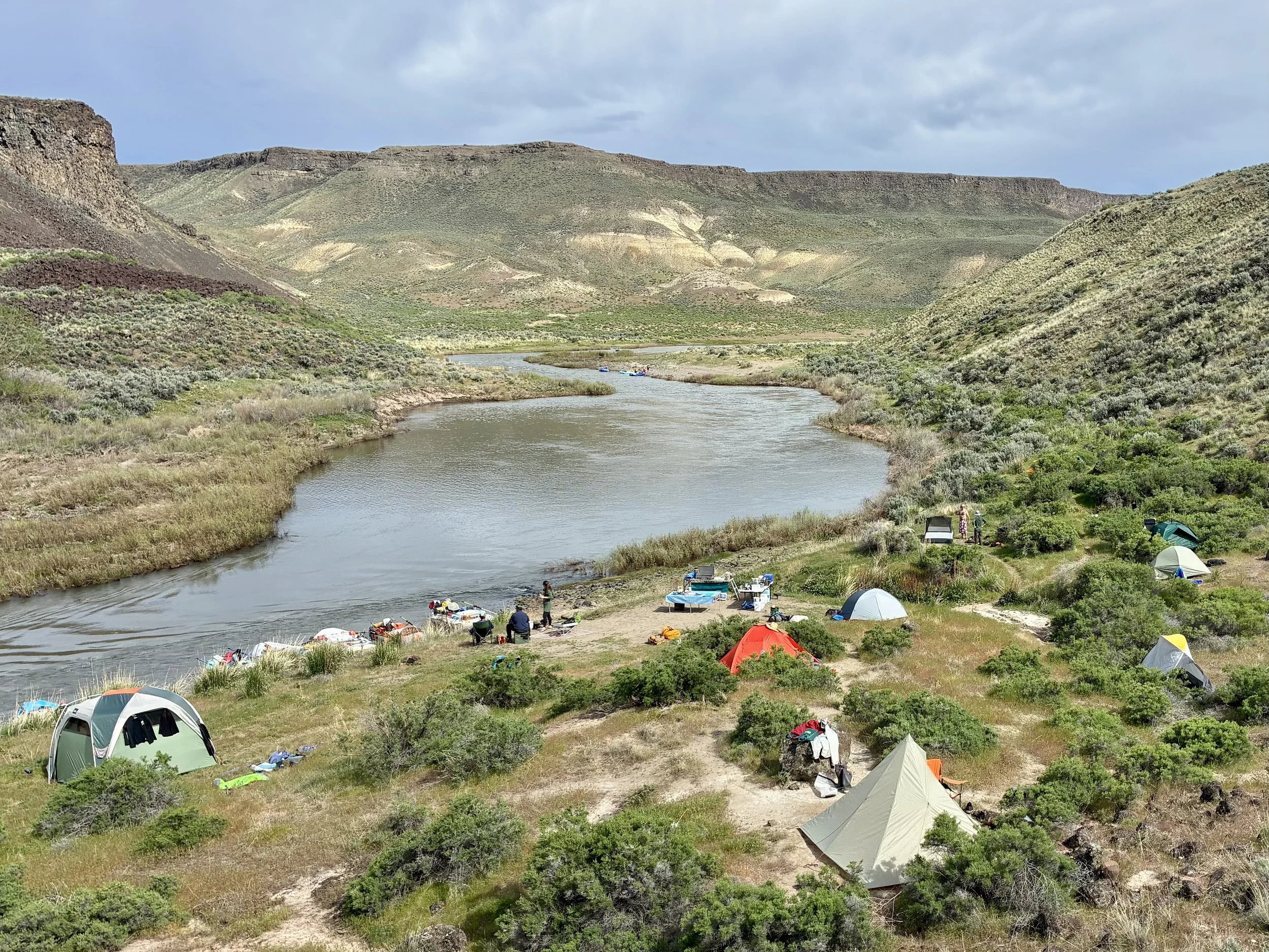
Camp. Photo courtesy of Jon Carl
Camping along the Owyhee is entirely primitive. Sites are first come, first served, limited to a single night, and entirely without infrastructure. Everything must be packed in and packed out, including human waste and ash. There is no certainty in where you will land each evening, only the understanding that the river will provide enough if you remain flexible.
If there is a misconception about multi-day river travel in a place this remote, it is that “primitive” equates to going without. The reality, at least for those willing to plan and share the load, is quite the opposite. Appetizers appeared without coordination, snacks were passed freely across boats, and beverages of all kinds circulated as naturally as conversation. With a full crew of committed potlatch-style contributors, meals became more than sustenance; they were a daily gathering point, a rhythm that anchored each evening, and we ate like royalty – halibut, enchiladas, ribeye steaks and endless options of everything in between.
That first night, under a sky that stretched wider than anything we had left behind, it became clear that while the Owyhee asks a great deal of you, it also holds space for a kind of richness that has nothing to do with excess and everything to do with intention.
Morning arrived not with silence, but with sound. Blackbirds gathered along the river corridor, their calls layering into a dense, almost overwhelming chorus that followed us downstream. It was both chaotic and cohesive, a reminder that this landscape, though remote, is far from empty. As we moved deeper into the canyon, the walls began to rise more definitively, narrowing the sky and pulling our attention inward.

Assessing the situation. Photo courtesy of Jon Carl
We passed the Weeping Wall later that morning, a striking geological feature where water seeps through layers of basalt and spills down the canyon face in thin, persistent streams. In a landscape defined largely by dryness, its presence feels improbable, almost delicate, and it offers a moment of pause – a reminder that even in harsh environments, there are quiet forms of abundance.
By the time we approached the stretch between Upset Rapid and Bullseye, we had begun to find a rhythm as a crew. Movements were more intuitive, communication more fluid, and there was a growing sense of confidence in how we worked together. That confidence, however, was quickly tested.
The rapid itself did not initially present as particularly intimidating. A large rock sat mid-channel, visible but seemingly manageable. We approached with a plan, but the river altered it without hesitation. A slight delay in response, a subtle misalignment with the current, and suddenly the situation shifted.
I pulled hard on the oars, attempting a late course correction, but the raft responded more slowly than I needed it to. The current caught us just off line, and in the next moment, I was high-sided out of the captain’s seat and into the water, pulled beneath the raft in a disorienting but sharply focused instant. There is a clarity that comes with submersion in moving water. Panic does not have time to take hold. Instinct overrides everything else. I opened my eyes, oriented myself beneath the raft, and kicked toward the edge of a tube. With a force that felt both urgent and deliberate, I pushed myself free and broke the surface.
The raft, still moving with the current, drove me into the canyon wall on river left. Before I could fully register the impact, I felt my partner’s grip on my shoulder straps. She pulled me back into the raft with immediate, decisive force.
What stayed with me wasn’t just the speed of the rescue, but the precision of it – the way she moved without hesitation, reading exactly what was needed in that moment and acting on it.
There is a kind of bond that forms between people in situations like that, not built on familiarity or even friendship in the traditional sense, but on something more immediate. You learn, very quickly, whether you can rely on someone when it matters. And in that moment, the answer was clear.
We didn’t need to talk about it. There was no acknowledgment exchanged, no pause to process. But something had shifted between us. A layer of trust had been established that didn’t require explanation, only continuation.
There was no time to linger in that realization. Another rapid waited downstream, and my partner was not ready to take the oars. The responsibility remained mine. I returned to the captain’s seat, still cold, still catching my breath, and adjusted to the moment as it was. The fear did not disappear, but it shifted into something more functional. It became awareness rather than hesitation. I moved forward.
The capacity to recalibrate and remain present without being overwhelmed became one of the defining skills of the trip. On a river like the Owyhee, you do not eliminate uncertainty. You learn to operate within it.
That night, we camped near Pruitt’s Castle, a striking geological formation just upstream from our intended stop at Ryegrass, where a series of hot springs sits along the river corridor. Once again, the Owyhee had reshaped our expectations. But over the course of the trip, those adjustments became less of a disruption and more of a rhythm. Plans were provisional; experience was immediate.
By the third day, the canyon had deepened in both scale and presence. I had been leading out each morning, without so much as a stretch, or sleep. My left arm was surging with nerve pain, exacerbated by a pinched nerve in my elbow. I was stewing in silent agony and had very little patience. When my rowing partner questioned my tie-down skills, I snapped. We finished rigging our boat with few words, as I felt a breakdown in our trust. Little more than a mile later, I couldn’t bear it any further, and I switched places with my rowing partner. The tension was still there.
And then came Nuisance.
Often described as one of the most technically challenging rapids on the Lower Owyhee, Nuisance earns its name through perseverance rather than spectacle. At lower flows, it becomes constricted and boulder-strewn, offering few clean lines and forcing continuous adjustment. We entered with attention, but even that was not enough to avoid consequence.
The raft struck a rock on river right and flipped.
In the instant before it did, I was launched from the high side, carried over my paddling partner and into the current. We remained together as we moved through the rapid, allowing the current to carry us to an eddy where we could regain footing and orientation. My rowing partner, now out of the captain’s helm, had managed to climb onto the rock that initiated the flip, maintaining position as the rest of the crew responded.
One raft moved immediately to assist us from the water. Another tracked and recovered the gear that had come loose, only one food box (that remained closed, though contents soaked) and a broken oar, both retrieved before they could be lost downstream with a coffee cup. Everything else tied down, remained in place (I know how to tie my stuff down.)

A reprieve from the action.
Reaching shore on river left presented its own challenge. The bank was dense with poison oak, and there was no viable alternative. We moved through it regardless, the immediate need outweighing the longer-term discomfort it would likely bring.
Cold settled in quickly once the adrenaline subsided. Wet clothing, wind, and exhaustion combined into a physical state that made even simple movement feel difficult. And yet, the task ahead remained. The raft had to be flipped, and that meant returning to the water.
Every instinct resisted. The cold had already taken hold of me, deep enough to affect both body and clarity of thought. But there was no option to delay. My rowing partner and I rigged a flip line and entered the eddy again, coordinating our effort across multiple attempts. It took sustained force – pulling, resetting, and pulling again – before the raft finally rolled upright.
By the time it did, we were depleted, but now we faced the next challenge as we were carried downstream in the current… we had to get back in our raft. After several exhausting attempts, we looked at each other and simultaneously asked each other why we just didn’t swim to shore? We were certainly close enough! Reaching shore, we crawled through the poison oak again, and with some assistance, landed on the next beach for hot beverages and lunch.
We had succeeded. Not individually, but collectively. And that distinction mattered.
After lunch, and a switch into warmer clothes, we continued downstream, where campsites appeared intermittently, some marked, others informal, each shaped by the natural contours of the riverbank. We reached Tanager, around mile thirty-seven, and played havoc in the wind, attempting to set up tents and clotheslines to dry out the soggy clothing that didn’t quite escape submersion. Once settled, I wandered into the landscape to explore the scenery from higher ground. As the sun lowered, the canyon walls shifted into shades of deep orange and gold, illuminating spires and formations that seemed sculptural in their precision.
By the fourth day, the challenges of the Owyhee converged into a series of defining moments. After finally getting more than a couple hours of sleep sitting up in my camp chair all night, I decided to take the first pull behind the oars, and captained Montgomery Rapid. The flow level presented a different kind of challenge. Rather than large, dynamic waves, it offered a dense field of exposed rocks and narrow channels. The difficulty lay in precision. Each movement had to be deliberate, each line chosen with foresight. The risk was not flipping, but becoming stuck, caught sideways in current with limited options for recovery. It demanded a level of focus that bordered on meditative. With my two paddlers in front, I took a deep breath and gently worked the oars to balance the strength between their cadence, and we sailed through the rock gallery with ease.
Whistling Bird was next – a technical Class III-IV rapid that requires precise navigation from the outset. The rapid bends sharply, with current driving forcefully into an undercut rock on river right—a feature that has earned a reputation for its potential consequences.
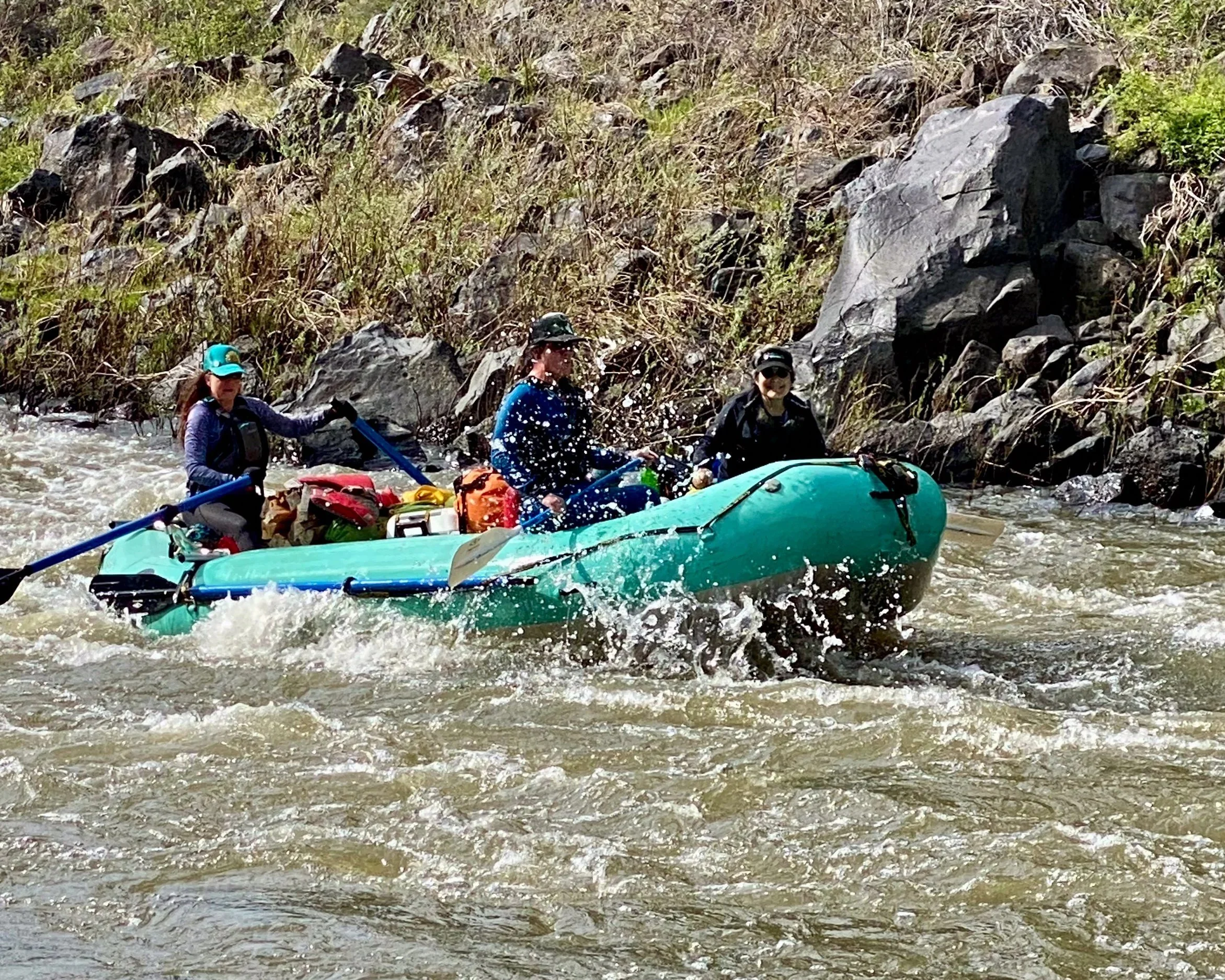
Navigating a rapid. Photo courtesy of Mark Taratoot
We scouted from river left, assessing the line and committing to a plan. Even with that preparation, the margin for error remained small. As we entered the flow, we found ourselves slightly too far right, the current pulling us toward the wall with increasing force. Sitting in the front of the boat, I could see the rising wall to my right.
There was no time for deliberation. I drove my paddle into the rock face and pushed, using the leverage to redirect the raft just enough to regain the main flow. The adjustment was minimal but sufficient. Our captain took over from there, guiding us through the remainder of the rapid without further incident.
The moment passed quickly, but its significance lingered. It was not just about execution, but about trust—trust in each other’s instincts, trust in our ability to act without hesitation, and trust that no one would override or second-guess in a way that compromised the whole.
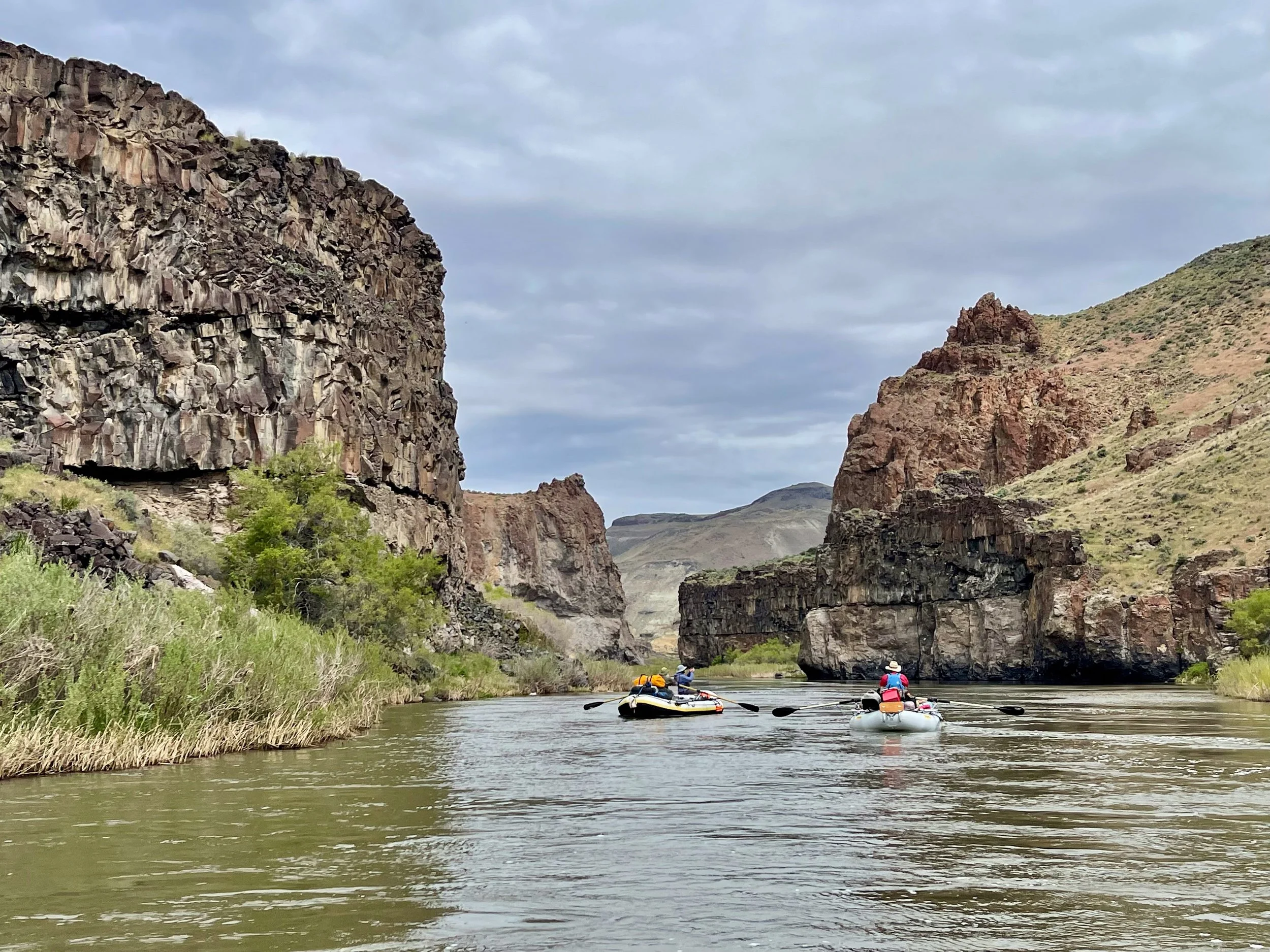
We continued to wind downriver, between towering canyon walls and a prodigious landscape of cathedrals and pinnacles before reaching our last campsite near the Basque campground. It was our last evening together (or so we thought) and we stayed up late, toasting to nature, camaraderie, and privilege to experience such a beautiful place.
The final stretch of our journey offered a stark contrast to what had come before. The river meandered through a series of wetlands and historical landmarks, including a homestead cabin site and a waterwheel, eventually widening into a reservoir, the current slowing until it became almost still. Following the exertion of the past few days, the calm felt both unexpected and deeply welcome.
We clipped the rafts together, forming a single, floating line, and used a small electric motor to carry us forward. The transition from effort to ease was immediate. It was, in many ways, a reflection of a broader pattern formed by periods of intensity followed by moments of release. Effort followed by rests… in its own way, the river mirrored the experience of moving through something difficult and emerging, however briefly, into calm.
We reached the take-out at Leslie Gulch near Jordan Valley and began the process of de-rigging and transitioning back to land. The access road, long and unmaintained, extended the experience of remoteness even as we prepared to leave it. And even then, the trip was not quite finished. A leaking radiator required us to stay one more night.
We gathered together once more, sharing what remained of our food and drink, and acknowledging, without needing to say it directly, that this experience had shifted something for each of us.
For me, the shift was internal.
The grief I had carried into the canyon had not disappeared, but it had changed. It no longer felt like something I needed to fight or resolve. Instead, it became something I could hold with a measure of steadiness.
My mother was nearing the end of her life and I could meet that reality without resistance. I could be present. I could accept what was unfolding without needing it to be different. When I think back on the Owyhee, it is not the moments of difficulty that remain most clearly, though they are vivid. It is not even the scale of the landscape, though that is unforgettable. It is her voice.
“It’s a beautiful morning.”
And the realization that she was right. Even at the edge of life, and perhaps, especially then.
The Owyhee continues to flow, carving its path through basalt and time, indifferent to human timelines and yet profoundly relevant to them. It offers no guarantees and no simplifications, but it provides something far more valuable. It creates space – space to confront what we carry, space to understand what matters, and space to let go.
Enjoy the story? Want to read more stories of adventure? Never fear, we have you covered. Click here!